

Farmland Values Flat to Modestly Lower in First Half of 2026
Champaign, IL, August 27, 2026 – Farmland prices have remained “flat to modestly lower” since the first of the year according to the Mid-Year Snapshot Survey conducted by the Illinois Society of Professional Farm Managers and Rural Appraisers. The results were discussed during a special FarmDOC webinar held today. The Mid-year survey is done annually as an adjunct to the more extensive Farmland Values and Lease Trends survey done by the Society in the spring of each year.
According to survey respondents, farmland prices were flat to modestly lower from January 1 to July 1. Average declines were 1.0% for excellent quality farmland, 1.9% for good quality, 2.6% for average quality, and 2.3% for fair quality farmland. The median respondent reported no change in every class: 39% reported no change in excellent quality farmland, rising to 67% for fair quality farmland.
Most respondents also expect farmland prices to remain stable during the second half of 2026: 61% expect prices to stay the same, 13% expect increases of less than 3%, and 8% expect increases of more than 3%. Of the remainder, 16% expect declines of less than 3% and a single respondent expects a decline of more than 3%.
Expectations on interest rates reversed. Of the respondents, 71% do not expect lower interest rates during the second half of 2026, 24% do, and 5% are unsure. At mid-year 2025, 76% expected lower rates.
Note: In the survey, references are made to different qualities of farmland. In a typical year, Excellent quality farmland averages over 230 bushels of corn per acre with a soil productivity index of 133 or higher. Good quality farmland averages 210 and 230 bushels per acre, with a soil productivity index of 117-132. Average quality farmland averages between 190 and 210 bushels per acre with a soil productivity index of 100-116 and no irrigation. Fair-quality farmland averages below 190 bushels per acre with a soil productivity index under 100.
The 2026 mid-year survey drew 50 responses from farm managers, land brokers, and rural appraisers, with all 10 of the Society’s regions represented.
Other details from the survey:
- The Survey indicated this distribution of farm buyers:
- 55% were farmers,
- 17% were local individual investors,
- 13% were non-local individual investors,
- 9% were institutions,
- 5% were recreational and lifestyle buyers, and
- 1% were other.
- The Survey indicates this distribution of farmland sellers:
- 64% were estate and post-estate settlements,
- 8% were farmers,
- 9% were local investors,
- 11% were non-local investors,
- 3% were institutions, and
- 4% were others.
- Respondents named reasons for selling farmland. Of those reasons:
- 31% were family farm succession planning,
- 20% were a need for cash,
- 19% were a good market price,
- 19% were a 1031 exchange,
- 11% were adjusting an investment portfolio, and
- 1% were other reasons.
- Of respondents, 3% were involved in a sale involving a farmer with financial difficulties, down from 11% at mid-year 2025.
- Of respondents transacting real estate, 26% had a transaction with an institutional investor.
- Of respondents transacting real estate, none reported a transaction with a foreign investor, down from 15% at mid-year 2025.
Expectations of Farmland Prices during the Second Half of 2026
- Of respondents, 49% expect more sales to be listings rather than auctions, 35% expect the mix to stay the same, and 16% expect more auctions. Listings here include both public listings and private treaty sales, so the comparison is auctions against all other methods of sale; the mid-year survey does not report private treaty transactions separately. Listings are often preferred in stable or declining price environments.
- Respondents lean positive on farmland prices in 2 years (2028): 45% expect higher farmland prices, 42% expect prices to be about the same, and 13% expect lower. No respondent expected prices to be much higher or much lower.
Cash Rents in 2027
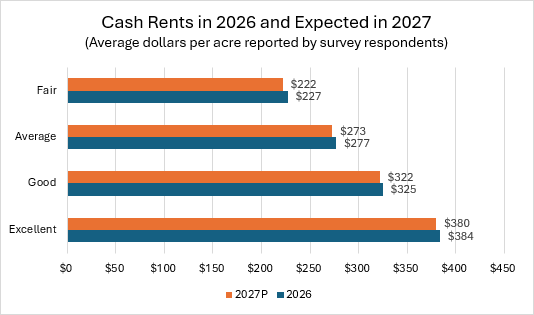
- Most farm managers expect 2027 rents to be close to 2026 rents, with average declines of $3 to $5 per acre. Between 50% and 69% of respondents expect no change at all, depending on land class.
- Average cash rents reported for 2026 and expected for 2027 were $384 and $380 per acre for excellent quality farmland, $325 and $322 for good quality, $277 and $273 for average quality, and $227 and $222 for fair quality farmland.
- Respondents expect market prices for the 2026 crop to be:
- $4.54 per bushel for corn, and
- $11.57 per bushel for soybeans.
- Of respondents, 46% expect another round of ad hoc disaster payments outside the legislated PLC and ARC payments, down from 76% at mid-year 2025.
Rental Arrangements
- Respondents indicated the following use of alternative farmland leases:
- 28% are share rent leases,
- 12% are modified share rent leases,
- 21% are cash rent leases,
- 35% are variable cash rent leases, and
- 4% are custom farming arrangements.
Over time, variable cash rents have increased, and share rent leases have declined.
- Farm managers expect that trend to continue into 2027: 52% expect greater use of variable cash rents and 29% expect greater use of fixed cash rents, while 45% expect less use of share rent leases.
- The average supplemental rent on a share rent lease is $35 per acre.
Variable Cash Rent Arrangements
- For variable cash rents, the most common arrangement has a base cash rent paid regardless of prices, yields, or incomes, with a bonus payment entered into the calculation based on revenue. Respondents named 62 lease terms in total; the shares below are of all terms named.
- 42% were a base cash rent paid regardless of prices, yields, or incomes,
- 39% were a payment made when revenue exceeds a specified level,
- 6% were a revenue payment beginning at zero revenue,
- 5% were a payment based on price,
- 5% were a payment based on yield, and
- 3% were costs of production entering the calculation of rent.
- Farm yields are used in 96% of the cases when yields enter rent calculations. County yields are used in the other cases.
- When price enters rent calculations, multiple prices at delivery points are the most common method for arriving at the price.
- 57% of leases use multiple prices at a local delivery point,
- 36% use futures prices, and
- 4% one price at a delivery point.
- Crop insurance and/or government payments are used to calculate rent payments in 29% of the leases.
- When gross revenue is used to calculate a bonus, the average percentage is 36% for corn and 40% for soybeans.
- Most respondents are satisfied with the performance of variable cash leases:
- 29% indicated they were very satisfied,
- 64% indicated they were satisfied, and
- 7% indicated they were neutral.
- Most respondents indicate that variable cash rent arrangements make negotiations easier as compared to fixed cash rent arrangements:
- 24% indicate that negotiations were much easier,
- 62% indicate that negotiations were somewhat easier,
- 10% indicate that negotiations were about the same, and
- 3% indicate that negotiations were somewhat harder.
- Most respondents indicated that lease terms do not change every year:
- 7% indicate that every year, some terms of the lease change,
- 68% indicate changes occur periodically, and
- 25% indicated that lease terms seldom change.
Wind, Solar, Battery Storage, and Data Centers
- Of those who managed farmland, 48% had a farm enter into a new wind or solar agreement during the first half of 2026: 26% entered both wind and solar agreements, 13% solar agreements only, and 10% wind agreements only.
- Annual lease rates offered for new utility-scale solar or wind contracts clustered between $1,000 and $1,999 per acre, reported by 63% of respondents. A further 31% reported $2,000 to $2,999 per acre and 6% reported more than $3,000 per acre. No respondent reported rates under $1,000 per acre.
- Battery energy storage entered the market. Of respondents, 33% received inquiries or entered option agreements for utility-scale battery energy storage systems during the first half of 2026: 22% for projects co-located with solar and 11% for standalone facilities.
- Seven respondents knew of a guaranteed annual base rent for a battery storage lease. Four were in the $1,500 to $4,999 per acre range, two between $5,000 and $9,999 per acre, and one at $10,000 or more per acre.
- An active wind, solar, or battery lease raises the price at which farmland transacts. Of respondents, 72% reported a moderate premium of 1% to 15% and 8% reported a significant premium above 15%. The remaining 19% reported no impact. No respondent reported a discount.
- Lenders have not visibly changed their approach to encumbered ground. Of respondents, 73% were unsure whether agricultural lenders are altering underwriting standards for farmland under long-term renewable energy leases, 24% saw no noticeable change, and one respondent reported stricter terms or higher scrutiny.
- Data center developers are active in Illinois farmland. Of those who managed farmland, 26% were approached by developers or brokers to sell or lease managed farmland for a data center project during the first half of 2026.
- Where data center development is occurring, developers are primarily seeking parcels of 100 to 250 acres, reported by 50% of respondents, followed by 250 to 500 acres (27%) and more than 500 acres (18%).
- Renewable development and 1031 exchanges are also shaping buyer intent. Of the buyer intentions, 17% were 1031 exchanges and 6% were renewable energy development. Operating the farm (32%) and renting it out (31%) remained the two most common intentions.
Copies of the 2026 Farmlend Values and Lease Trends Report are available at no charge for the pdf document as a download at www.ispfmra.org. The 2027 Illinois Farmland Values Conference will be held a the Doubletree by Hilton in Bloomington on April 1.