
FAIRCHILD WAS SECOND-LONGEST SERVING PRESIDENT AT ILLINOIS STATE
Twenty-Two Years as President, Through Depression and World War II
By Tom Emery
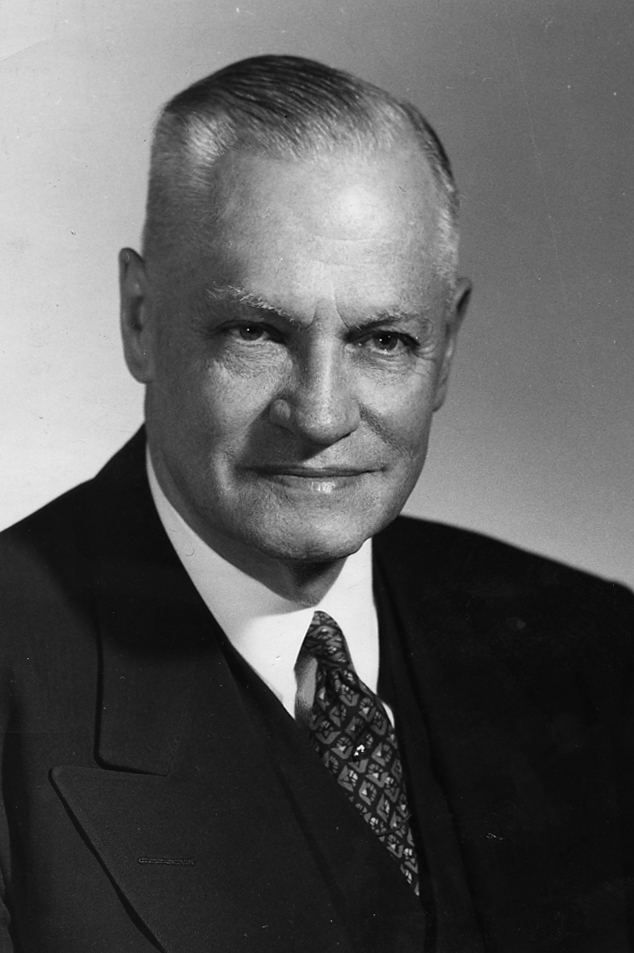
Raymond Fairchild was the second-longest serving President in Illinois State University history, guiding the school from 1933-55. In his tenure, he led the school through the pitfalls of the Great Depression and World War II.
June 11 marks 70 years since the death of Fairchild, who remains one of the most influential figures in university history, though some historians debate the extent of his impact.
Born on Sept. 9, 1889 in the eastern Illinois town of Bismarck, Fairchild was the son of a Methodist minister and former instructor at Illinois Wesleyan University.
Fairchild would later attend IWU himself, and continue his education with a B.A. in biology at the University of Michigan. Fairchild earned an M.A. from the University of Chicago and a doctorate from Northwestern University.
Prior to his arrival at Illinois State, much of Fairchild’s career was spent on the high school level. He opened his career as assistant high school principal at Vandalia in 1909-10, followed by four years in the same position at moline.
From 1914-20, Fairchild served as chair of the biology department and Dean of Men at Wisconsin-Stevens Point, followed by three years as the superintendent of schools at Fond du Lac, Wis. Fairchild was the superintendent of schools at Elgin, Ill. from 1923-30, then was a professor of education and head of the Chicago campus at Northwestern from 1930-33. One ISU source calls Fairchild “a well-known educator in the region.”
When Fairchild was appointed President of ISU in 1933, he was the first leader in university history to hold a doctorate. He succeeded Harry Brown, who was forced to resign amid allegations of academic misconduct at the University of Wisconsin-Oshkosh, where Brown had served as President before his appointment at Normal. Brown’s departure marked a turbulent time in the history of Illinois State.
Among his first duties, Fairchild was charged with improving the accreditation status of Illinois State, including the preparation of faculty.
Admissions standards were raised under Fairchild, while faculty were encouraged to earn advanced degrees. Relations between Illinois State and public schools were also enhanced.
One of Fairchild’s great accomplishments at Illinois State was the introduction of graduate coursework. At the time, few “normal,” or teacher training, colleges offered graduate-level study. Under Fairchild, Illinois State became the first normal school in the state to provide graduate courses as part of the curriculum.
Fairchild also worked strenuously to introduce special education to the ISU curriculum. It was a ground-breaking move, as the university became one of the first in the United States to offer top-quality training in special education in all disciplines. In 1951, a new special education building at ISU was named in Fairchild’s honor.
It was just one of many new structures that Fairchild oversaw during his tenure. Fairchild took advantage of increased federal funding in the World War II era to construct the first Milner Library (now Williams Hall), Hovey Hall, the first Cardinal Court, the first Student Union (now the Old Union), Metcalf Elementary School, Rambo House (since demolished), Dunn-Barton Hall, Dunn Hall, and Walker Hall.
Indeed, the campus underwent a remarkable transformation under Fairchild’s guidance. Many of the university’s centennial celebrations of 1957 were planned under Fairchild.
In her centennial history of ISU, instructor Helen Marshall heaps praise on Fairchild’s accomplishments, calling him an “architect and builder” with “the clean, vigorous look of an athlete [with] warmth and strength in his firm handclasp” and “blue eyes [that] were friendly and kind and fun-loving.”
**Editor’s Note: If you find the story here of value, consider clicking one of the Google ads embedded in the story. It costs you nothing but Google will give the website owner a few cents. This is a way to help support local news at no cost to the reader.
However, modern historians, particularly former ISU professor John Freed, point to several of Fairchild’s flaws. Among them were his insistence that Illinois State remain solely a teacher-training institution; the university was the last of the normal schools in Illinois to change its name.
In addition, Freed and others believe that Fairchild did not do enough to promote diversity on the campus, at a time when some other institutions were embracing social change.
Fairchild operated the university more as a public school superintendent than a university professor, causing many of his subordinates to chafe. In addition, Fairchild’s rigid opposition to alcohol, as well as his minute attention detail and reluctance to delegate authority, also caused problems.
Freed writes Fairchild was “a bureaucrat rather than a visionary” and “a generation of faculty members hired after World War II remembered [Fairchild] as an out-of-touch, authoritarian school administrator.”
However, Fairchild remains an imposing figure in the story of Illinois State. His health began to fail rapidly late in his administration, though the exact diagnosis is unknown. On June 22, 1954, his right leg was amputated above the knee.
Fairchild stepped down from the Presidency on Aug. 15, 1955. He was hospitalized for much of his final two years, and died on June 11, 1956.
An editorial in the Bloomington Pantagraph implied that Fairchild’s health was broken by his unyielding devotion to Illinois State. The paper summarized Fairchild’s death as “a full life of service ends…his was a truly dedicated life, used up to the limit, on behalf of present and future generations.”
Tom Emery may be reached at 217-710-8392 or ilcivilwar@yahoo.com.