


Waymo begins testing in Chicago as bill seeks to legalize autonomous vehicles
Labor, driving unions are raising concerns over safety, job loss
Article Summary
- Autonomous vehicles, known as AVs, currently are being tested on the streets of Chicago.
- A bill in the legislature would eventually allow such driverless vehicles to operate in Illinois counties that have more than 1 million residents, plus Sangamon and three downstate jurisdictions. They could replace rideshare and taxi drivers.
- The bill has a long road ahead before legalization can occur and currently is held up in committee.
By JACQUES ABOU-RIZK
Medill Illinois News Bureau
news@capitolnewsillinois.com
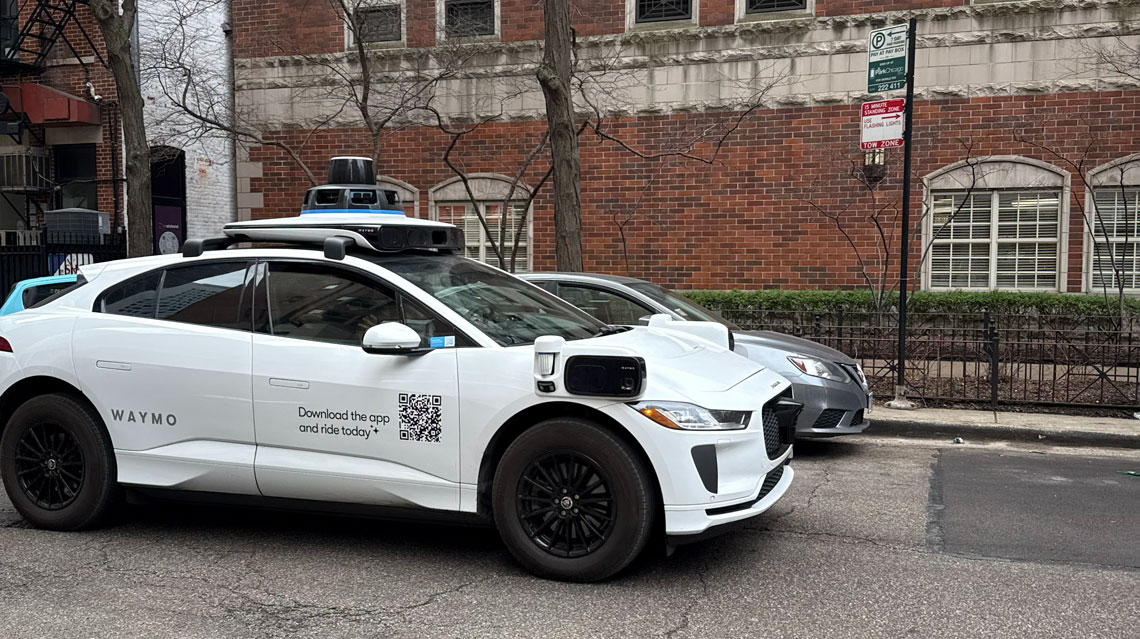 CHICAGO – In downtown Chicago, people have been spotting Google’s Waymo automated vehicles testing and mapping the Windy City’s streets. For now, the autonomous vehicles must be driven by a human, as the industry seeks the endorsement of state lawmakers.
For the last year, legislators in Springfield have been trying to work through a variety of issues raised by skeptics of the autonomous vehicles, known as AVs. Rep. Kam Buckner, D-Chicago, said AV legislation has a long road ahead to address constituent concerns over safety, insurance and job losses for rideshare and cab drivers.
**Editor’s Note: If you find the story here of value, consider clicking one of the Google ads embedded in the story. It costs you nothing but Google will give the website owner a few cents. This is a way to help support local news at no cost to the reader.
In January, he introduced the Autonomous Vehicle Pilot Project Act, which would open counties in Illinois with over 1 million residents, as well as the counties of Sangamon, Madison, St. Clair, and Monroe, to automated commercial vehicles. But the bill has since been held up in the Rules Committee, an early step in the process that means it’s far from passage, especially in the current legislative session. Other bills supporting the industry also have yet to get the necessary support.
While Waymo has started testing its vehicles with safety drivers in Chicago, the company has not yet announced plans to bring the robotaxis to counties other than Cook, according to Waymo spokesperson Chris Bonelli.
Automated Vehicle legislation in Illinois
Waymo only fully operates in Arizona, California, Florida, Georgia and Texas — warm weather states where concerns about handling icy conditions are not as big an issue.
<div class=”flourish-embed flourish-chart” data-src=”visualisation/27942625″><script src=”https://public.flourish.studio/resources/embed.js”></script><noscript><img src=”https://public.flourish.studio/visualisation/27942625/thumbnail” width=”100%” alt=”visualization” /></noscript></div>
The company has faced significant questions over the safety of its vehicles and fully automated taxis. A subsidiary of Alphabet, Waymo is under multiple federal investigations for traffic violations, including illegally passing stopped school buses. Company vehicles have also made headlines for blocking emergency vehicles and hitting a child near an elementary school.
In a statement, Bonelli said Waymo is committed to “continuous improvement,” adding, “While rare incidents will occur over the more than four million miles we drive every week, our entire fleet can learn from these events and continue to make our roads safer.”
According to company data, Waymo vehicles are involved in 92% fewer crashes with serious injuries compared to an average human driver in the same city.
Among some legislators and observers, it seems a matter of time before legislative compromises eventually produce a bill that will pass to allow AVs to operate without the safety drivers.
**Editor’s Note: If you find the story here of value, consider clicking one of the Google ads embedded in the story. It costs you nothing but Google will give the website owner a few cents. This is a way to help support local news at no cost to the reader.
Rep. Brad Stephens, a Republican who is also the mayor of suburban Rosemont, introduced his own AV bill last Spring. He said he sees a bright future for AVs in Illinois, but he acknowledged that it might not pass this session.
“It’s going to be a challenging two-and-a-half months with a lot of other issues,” Stephens said.
‘Still in the negotiation phase’
P.S. Sriraj, director of the Urban Transportation Center at University of Illinois Chicago, outlined a host of challenges for AV safety in the state, but he also said he believes the vehicles eventually will become part of life here.
State officials, he said, should look for ways to implement new automations responsibly.
The public benefit of AVs includes widening options for people who live in areas where there are few rideshare drivers or taxis. People with mental or physical disabilities around the state also could greatly benefit from AVs.
“All of the mobility needs of a population are so diverse that these types of technological advancements could play a role,” Sriraj said.
But, like others, he said he understands there are real concerns about safety, especially if AVs are to be allowed in smaller towns and counties.
“If the infrastructure is not set up to support this kind of a technology, for example, if there is no lane marking visible, at least to the naked eye, on a rural road, then what will happen to the technology?” he said.
WAYMO GARAGE IMAGE
Labor lobbyist groups are at the forefront of opposition to Waymo, arguing that automation will threaten driver and laborer jobs.
Ronnie Gonzalez, a representative of the International Association of Machinists and Aerospace Workers, said it’s vital that labor is part of the conversation before any legislation is passed.
“In labor, throughout the industrial revolution, we’ve been watching technology replace workers year after year, and it’s only sped up in the recent decade,” Gonzalez said. “The realization is it’s going to happen, so having a seat at the table lobbying for legislation that implements the use of autonomous vehicles responsibly, that is mindful of workers, mindful of safety, is what labor is pushing for.”
His association is part of the Illinois Drivers Alliance, a coalition of thousands of rideshare drivers across the state fighting for unionization. He said he hopes to engage in conversations with Buckner about specifics in the bill.
“We are still in the negotiation phase,’’ Buckner said, “walking and talking through what the issues may be, what the concerns may be, and trying to find a way to arrive at a version of this bill that works for everybody.”
‘On a bigger scale than just driverless taxis’
Across labor unions, there is agreement that AVs could threaten some of the estimated 100,000 rideshare drivers. Marc Poulos, executive director of labor management operations at the International Union of Operating Engineers Local 150, said Waymo operations are just a step toward further automation of labor jobs.
“We need to be thinking of this on a bigger scale than just driverless taxis,” he said. “Meaning it can impact whole industries like operating engineers and Teamsters and a whole bunch of others. Every time we just move to a technological advancement, we need to take into consideration, what does that mean to the overall economy?”
Sriraj said plans must be made to counteract any impact on the labor market: “If jobs are going to be reinvented, people will have to be retrained, and the corrective actions will always happen within society on their own,” he said.
“At least until the 1970s, elevators had an elevator operator, and then people became accustomed to just punching a button and riding in an elevator on their own,” he said. “Now there is no elevator operator job anywhere to be found. Did that mean that that section of population actually starved to death?”
Resistance to AVs in Illinois also includes two groups with differing constituents but similar concerns about safety.
Safety, insurance concerns
Tim Cavanagh, the president of the Illinois Trial Lawyers Association, has spoken out about the need for requirements that AV operators have adequate insurance to cover any injuries or damage involving the cars.
“The current legislation doesn’t speak to financial responsibility,” Cavanagh said. “All it talks about is that they shall have at least the minimum requirement of insurance coverage.”
But, he said, the minimums should be far higher for AVs, and the well-financed companies behind them, than they are for individuals.
Josh Witkowski, the president of the Illinois motorcyclist rights organization ABATE, also has voiced strong opposition to AV deployment in the state because of the risk he says they pose to motorcycles.
He also points to icy conditions and low visibility in Illinois, as well as poorly lit roads and street markings downstate as challenges for AV technology, which relies on cameras and sensors to safely navigate roadways.
In response to weather concerns, Bonelli said Waymo already serves in cities that receive annual snow with freezing temperatures.
“The Waymo Driver has proven it can generalize to new cities, and we’ll continue to validate our performance for harsh winter weather conditions, such as those we’ll experience in Chicago,” Bonelli said.
He added, “Waymo has invested in weather testing since its earliest days as Google’s Self-Driving Car Project, and we’ve regularly tested in various conditions from coast to coast, building our technology for all-season operations.”
The past two winters, Bonelli said, Waymo has tested and validated its systems in multiple winter markets, including Detroit, New York City and Buffalo.
Read more: How Illinois’ Road Fund will help fund transit, especially in the Chicago region
Witkowski said more work needs to be done to ensure a proper rollout of AVs, with an oversight panel and publicly available data.
Jacques Abou-Rizk is a graduate student in journalism with Northwestern University’s Medill School of Journalism, Media and Integrated Marketing Communications, and is a fellow in its Medill Illinois News Bureau working in partnership with Capitol News Illinois.
Capitol News Illinois is a nonprofit, nonpartisan news service that distributes state government coverage to hundreds of news outlets statewide. It is funded primarily by the Illinois Press Foundation and the Robert R. McCormick Foundation.