


NEUROFIBROMATOSIS IS LITTLE-KNOWN, YET DEVASTATING DISEASE
Can Cause Seizures, Disfigurement, Loss of Hearing, Vision, Speech; No Known Cure
By Tom Emery
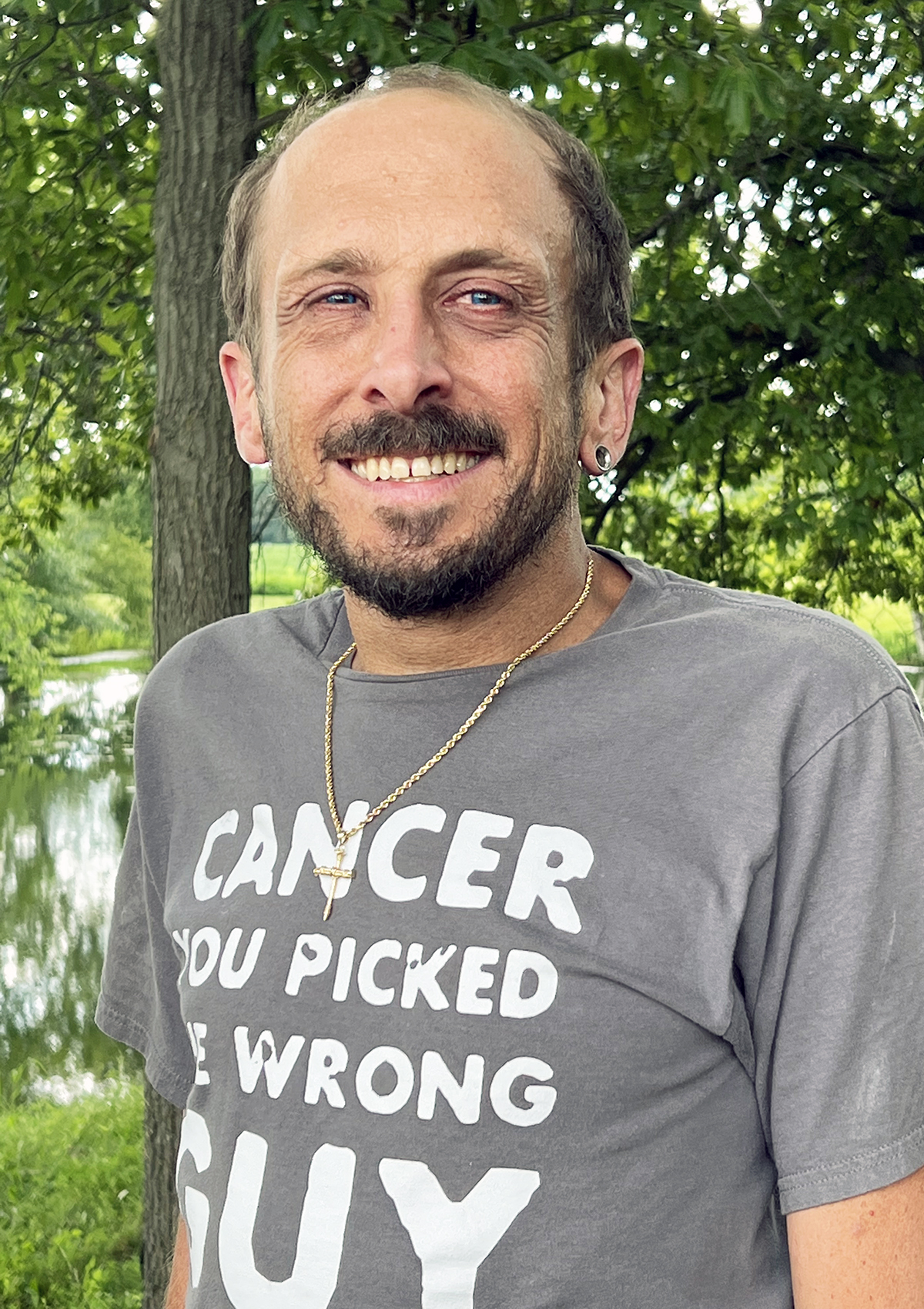
When Peter Oswald learned in 1988 that his four-year-old son, Sam, had been diagnosed with neurofibromatosis (NF), he was stunned and confused.
“I’d never heard of the disease,” said Oswald, a resident of Carlinville, Ill., 60 miles northeast of St. Louis, “and it seemed that no one else had, either. I remember spending hours every evening in our local libraries, trying to learn as much about it as I could, because I wanted to know what we were dealing with.”
Many others, then and now, have not heard of NF, which affects 1 in every 2,500 worldwide and is most often noticed in childhood or early adulthood. The disease appears equally across sexes, races, and ethnic groups.
Among the many, wide-ranging effects of NF are scoliosis, seizures, motor delays, vision or hearing loss, disfigurement, bone deformities, speech impediments, loss of balance, and lifelong physical pain.

Patients of NF routinely suffer from tumors on nerves across the body, and several separate, distinct versions of the disorder are currently classified. NF is classified as 50 percent hereditary and 50 percent a genetic mutation.
Despite its many horrific symptoms, this debilitating disease has a startling lack of awareness in the mainstream. Though less familiar to the general public, more patients suffer from NF than muscular dystrophy, Tay-Sachs disease, and Huntington’s disease combined.
*****
For those who struggle with NF, however, the disease is a part of their daily lives, and is a never-ending fight.
Since his diagnosis, Sam Oswald, now 41, has battled spinal fusion, two brain tumors, shunt revisions, bone grafting on both legs, knee surgery, dermal tumor removal, and eye surgery.
In July 2020, Sam underwent major surgery to remove a tumor in his chest, near his esophagus. That was followed by another operation in March 2021 to remove a tumor from his thigh, which was a reoccurrence with a bout of cancer from nine years before.
 In that earlier bout, a fist-sized, highly aggressive tumor was located inside Sam’s sciatic nerve, which is normally a quarter-inch wide. The nerve was removed after two surgeries, followed by very heavy, localized radiation and chemotherapy.
The procedures were done at Barnes-Jewish Hospital’s Siteman Cancer Center in St. Louis, and benefitted from research on Sam’s particular type of tumor by Washington University researchers.
“That was probably the riskiest surgery Sam has faced,” said Peter Oswald. “It’s a little scary when the first course of treatment to be considered was amputation.” Sam remains on a schedule of periodic scans to assess any reoccurrence of cancer.
“NF is really hard, and I have to deal with it practically every day,” said Sam Oswald. “But I’ve been really fortunate, too. I’ve had successful treatments for my NF symptoms over the years, and I have a really supportive family.
“I know that isn’t the case for all NF patients, because I’ve met many who haven’t had my level of support,” continued Sam. “So I know how lucky I’ve been, even with all I have to deal with.”
*****
Though awareness and research are still lacking, much has changed since Sam was first diagnosed. His father gives credit to NF Midwest, Inc., an organization that provides research grants and support services in Illinois and five surrounding states, with leading the fight.
“Back then, the only way to find information was through a lot of research, on your own,” said Peter Oswald. “But there have been great gains in NF research, public awareness, and support services. There’s a lot more information and assistance today than there was thirty years ago.”
“You also learn that you’re not alone,” continued Oswald, with evident emotion in his voice. “There are others who are having to deal with this, too. And there are more of them than you’d think.”

Research has also led to many improvements in the approach to treating NF. Thanks to research breakthroughs, the gene for NF has been identified, so a diagnosis may be verified by genetic testing.
Oswald adds that Sam has benefitted from new treatments several times in his struggle with NF. “It reinforces the need for research to better understand this disease, and potential treatment options,” he said. “It’s a disorder with no cure.”
For more information or to support the fight against the disease, visit NF Midwest at www.nfmidwest.org.
Thanks to his determination and the support of loved ones, Sam lives on his own in Carlinville, and is able to get around with the help of a three-wheeled bicycle.
“NF can be a struggle, and often is,” Sam said. “But I’m really grateful for what I’m able to do.”
Tom Emery may be reached at 217-710-8392 or ilcivilwar@yahoo.com.